
Windows into CECOT: Torture, Terror, and the Way Forward
Kilmar Abrego Garcia's recent testimony provides an insider account of El Salvador's CECOT prison, and an opportunity to rehumanize our country's immigrants.


It’s been a busy few weeks in American politics. Top-of-mind has been President Trump’s signature policy act, the “Big Beautiful Bill,” a nasty (and unpopular) piece of legislation set to cut Medicaid, make ICE the highest-funded federal law enforcement agency in history, and balloon the deficit by continuing tax cuts for the rich. Despite the opportunity to hyperfocus public attention on this historically bad policy, a number of Democrats have found time to be wishy-washy or outright hostile towards democratic socialist Zohran Mamdani after his resounding victory in New York City’s Democratic mayoral primary, wasting their critical public salience budget in favor of punching left. The New York Times even mustered three (3!) reporters to let a ‘scientific’ racist share hacked Columbia University admissions data showing Mamdani, a South Asian man from Uganda, scandalously listed himself as both Asian and African-American. (It should not go unstated how difficult it would be to imagine a similar reaction if the sexually abusive Andrew Cuomo had won instead.) In the midst of this, of course, was the potential for war with Iran, allowing war hawks to sharpen their talons in gleeful anticipation of possible regime change.
In this context, I worry one of the most important pieces of news threatens to fall by the wayside: following his return to the United States, Kilmar Abrego Garcia has been able to provide firsthand testimony of the heinous conditions in El Salvador’s Terrorism Confinement Center (CECOT) prison. Abrego Garcia is the only incarcerated person known to have left the facility alive, and his account provides a more intimate understanding of what deeply fascistic propaganda has strongly implied and available reporting has repeatedly demonstrated – CECOT is a torture facility, constructed to functionally end human lives.
For those who do not remember, in March, Abrego Garcia was kidnapped by ICE agents in Maryland, and illegally deported to El Salvador by the Trump administration in defiance of a judge’s order that he could not be sent to the country for reasonable fear of gang persecution. Abrego Garcia became a stand-in for the callous carelessness of the Trump administration’s mass deportations, as the government initially admitted sending him to El Salvador was an “administrative error,” before insincerely claiming it could not compel El Salvador’s government to release Abrego Garcia. At the same time, the President of El Salvador, Nayib Bukele, also pretended he could not return Abrego Garcia, cynically asking reporters during a White House visit, “How can I smuggle a terrorist into the United States?” After weeks without clear details on his well-being, U.S. Senator from Maryland Chris Van Hollen was able to secure a meeting with Abrego Garcia in April. This was quickly spun into Bukele-regime propaganda, as his Twitter account published photos of the meeting captioned, “Kilmar Abrego Garcia, miraculously risen from the “death camps” & “torture”, now sipping margaritas with Sen. Van Hollen in the tropical paradise of El Salvador!”

In early June – and despite Homeland Security Secretary Kristi Noem’s claim that “There is no scenario where Abrego Garcia will be in the United States again” – Abrego Garcia was returned to the U.S.to face human smuggling charges in Tennessee, which brings us to his account of conditions at CECOT. Although Bukele had dismissed “death camps” and “torture” as sensationalized, Wednesday’s court documents appear to describe exactly that.
Upon arrival at CECOT, Abrego Garcia alleges he and other detainees were told by a prison official, “Welcome to CECOT. Whoever enters here doesn’t leave,” before being forced to strip and change into prison clothes – all the while being struck and beaten by prison guards. Soon, Abrego Garcia and other members of his cell were forced by guards to crouch in a kneeling position from 9:00pm to 6:00am, again being beaten if the men collapsed from exhaustion. Without access to a toilet during this period, Abrego Garcia claims to have “soiled himself.”
Abrego Garcia reports that a week after arrival, he and eight others were separated from the twelve other Salvadoran detainees brought to CECOT, as Salvadoran officials had “information and belief [Abrego Garcia and the eight others] had no gang affiliations or tattoos.” Assuming the Salvadoran officials were correct in their assumptions, this would imply 43% of the Salvadorans deported to CECOT did not have clear gang affiliations. This number is a remarkably high number considering, as the prison official who greeted the detainees made clear, CECOT is not as much a holding facility as it is a waiting facility; a place for people marked for death by their governments to stay until they expire.
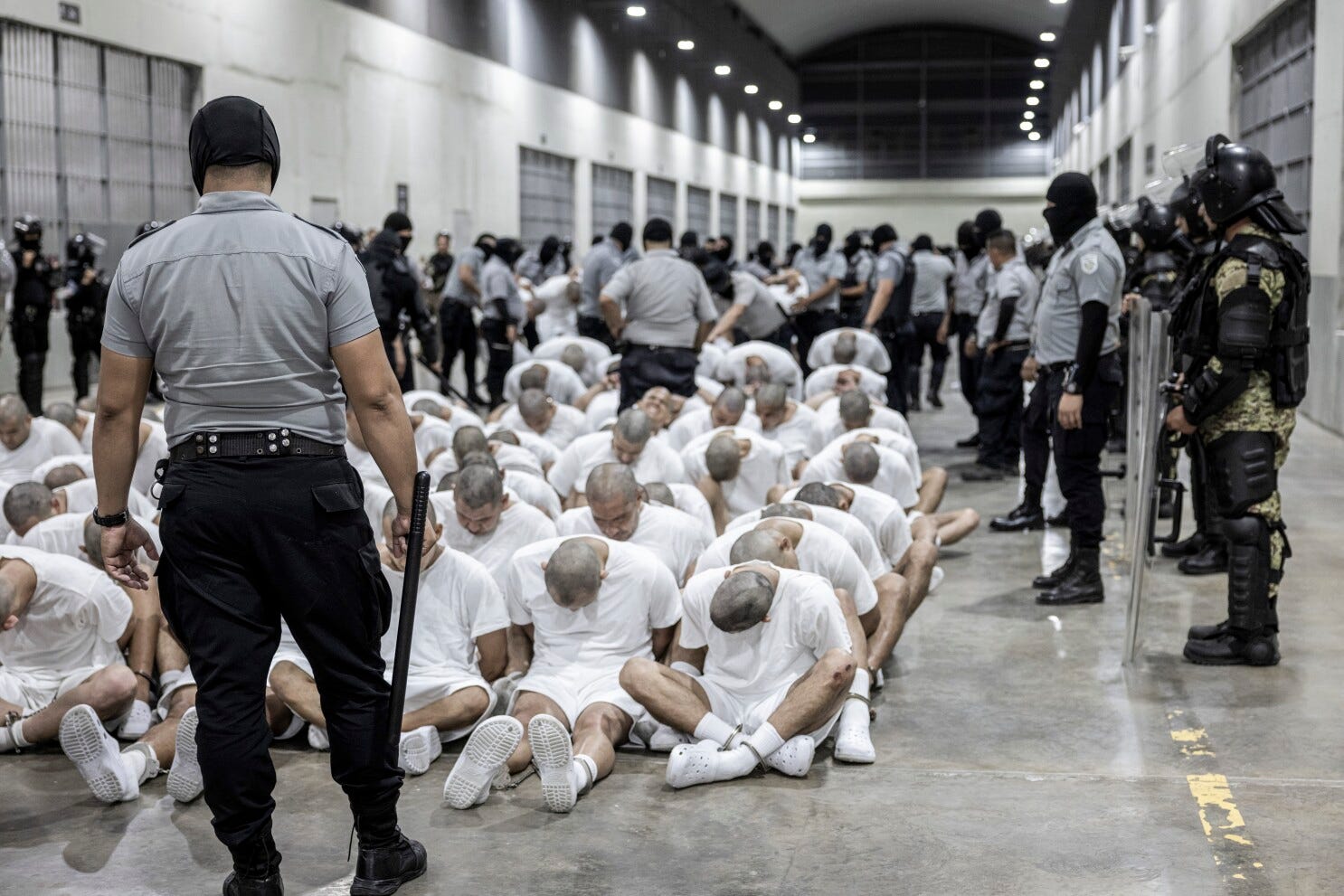
As Abrego Garcia relayed, he witnessed “prisoners in nearby cells who he understood to be gang members violently harm each other with no intervention from guards or personnel.” The purpose of CECOT is to facilitate the death of its inmates. As mass slaughter by guns, gas, or bombs should (but, as Israel’s genocide in Gaza demonstrates, not always) bring on international outrage and threaten a full stop to the killings, a semi-hidden, slow suffocation can achieve a similar goal. When tortured inmates kill each other, this is seen as a somewhat regrettable but inevitable fact of life in dangerous places. This is wrong, and CECOT’s slow twisting of the knife in its habitants’ chests is hardly better than if the government had elected to just slit their throats. In April, the executive director of the Salvadoran human rights group Cristosal, Noah Bullock, told the New York Times, “The physical abuse combined with that systematic denial of basic necessities, according to our research, has caused the deaths of at least 368 people. We think that it’s probably many more.”
That the actions of the Trump administration are not surprising nor barely a scandal evidences the dangerous extent to which immigrants have been thoroughly dehumanized in American society. The phrase “illegal alien” implies people who have often committed merely a civil offense (a category of infraction also including traffic tickets) are a different type of person altogether. An “alien” is not “human,” and as such “aliens” can be robbed of their due process, beaten with impunity, or sent to torture camps in El Salvador. There is no justification beyond bare racism and cruel bloodlust for the Trump administration’s behavior. Unless one believes immigrants are not human beings, it is an easily apparent violation of our most basic moral norms. Unfortunately, many in our society have apparently lost this ability to view immigrants as the same type of human they are. As long as this remains unchanged, the current persecution of immigrants will continue to worsen.

The United States government accidentally sent Kilmar Abrego Garcia to a torture camp in a foreign country, before lying that they had no power to return him, and even musing about sending “home-growns” – American citizens – to the torture camp next. Abrego Garcia’s story should be an opportunity to make ICE and the Trump administration’s depravity clear to everyday folks. Americans are broadly aware (73% had at least heard of the case in April) that someone was sent illegally to El Salvador, and Abrego Garcia’s pre-existing notability and unique information – even if he may not reinforce the “perfect victim” structure – could allow activists to make plain what is obvious to those paying attention: immigrants are now treated as second class human beings, subject to whatever violence the state or its supporters allows. The avenues for resistance today are narrow, but the widest lane still sits with the people. Progress has been made (recent polls show 54% of Americans say ICE has “gone too far”), but more action is needed. Everyone in America needs to be aware of the conditions at CECOT and other immigration facilities, and testimonies like Abrego Garcia’s need to be at the center of these efforts. Abrego Garcia and other targets of the state provide an opportunity to put faces to the dehumanized and restore a common belief that everyone, regardless of imaginary lines in the sand, must be treated with dignity.